



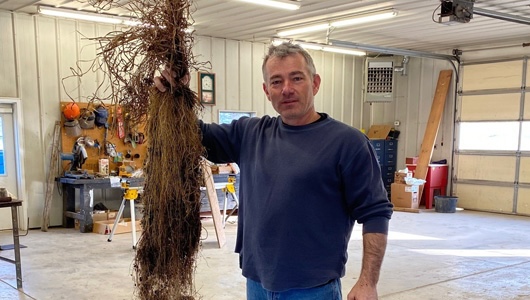
If you’ve ever wondered how native plants go from wild prairies to conservation superheroes, meet one of many people behind the magic in Missouri: Ron Cordsiemon, Missouri’s Plant Materials Center (PMC) manager and resident plant-powered problem solver. With more than 25 years at USDA’s Natural Resources Conservation Service (NRCS), Ron has turned his early passion for wildlife—sparked while baling hay, running equipment, and summers with the Missouri Department of Conservation—into a career rooted in developing plant-based conservation solutions. Today, he leads the research and operations that help conservation thrive across the region. In this edition of Ask the Expert, Ron shares the science, stories and people behind native plant conservation.
What is a Plant Materials Center (PMC) and how do they support conservation?
PMCs work with local NRCS field offices, landowners, farmers, ranchers and partners to develop plant-based solutions for conservation challenges. Think of PMCs as plant testing hubs. They test native grasses, forbs, shrubs, and trees to select the most valuable players for resource concerns like improving grazing lands and wildlife habitat, preventing soil erosion, boosting drought and flood tolerance, and stabilizing streambanks. PMCs produce foundation seed and starter plant material from selected varieties, which they provide to commercial growers so these plants can be made widely available to the public. PMCs also develop practical guidance—like seeding rates, site prep tips, and management information—that helps landowners successfully use conservation plants on their farms and working lands.
Where are PMCs located and how do they work together for a greater impact?
There are 25 PMCs across the country, each serving a different region- but they don’t work in isolation. Centers often team up on regional and national projects when they are tackling similar conservation challenges. For example, the New Jersey and Louisiana PMCs focus heavily on coastal issues like stabilizing dunes and restoring marshes, while PMCs in Arizona, New Mexico, and West Texas study plants that can withstand extreme drought.
Here in Missouri, the Elsberry PMC sits on 215 acres of land, near the Mississippi River Valley and serves parts of Iowa, Illinois, and Missouri. The team focuses on water quality and soil health, from promoting cover crops to testing reduced tillage systems. We’re also evaluating planting rates and dates for cover crops, to tighten recommendations for farmers using the cover crop practice.
What information do PMCs offer to landowners to help them succeed?
PMCs produce a wide range of practical, field-tested information, including study reports, technical notes, plant guides and more that support the success of NRCS conservation practices. PMCs host more than 3,000 of these resources online for public use. The Elsberry PMC contributes to this library with its own research studies and annual activity reports.
How do PMCs evaluate new plants to use for conservation?
When NRCS field staff and partners identify resource concerns that lack an effective solution, or discover native plants with promising traits, they contact the PMC. Field staff collect seeds or cuttings of targeted plants that make for a good solution, send them to their local PMC where they are assembled and each individual collection is assigned an identification number to enable tracking through testing.
At the PMC, we grow the plants and compare them to other collections over several years to see which ones have the traits needed to solve real conservation challenges. The most valuable plants are regrown in isolation to ensure those traits hold up in field conditions. Only after multiple rounds of testing does a plant move forward for potential release.
How can farmers or ranchers access seed or plant materials developed by PMCs?
PMCs do not sell plant materials directly to the public. Instead, once plant varieties prove to be a good fit for the conservation goals of commercial growers, PMCs produce that seed or plant material and provide it to commercial growers. Growers then produce enough seed or vegetative material to meet the public demand and private landowners can purchase it on the market -- often for use in NRCS conservation practices.
Does the Elsberry PMC work with partners?
Yes, partnerships are a big part of our work here at the Elsberry PMC. We collaborate regularly with different universities and agencies on projects that tackle shared natural resource concerns. Most recently, we worked with the University of Missouri, studying soil health and nutrient runoff in a corn-soybean rotation using cover crops. We also worked with Lincoln University to test whether small remnants can control invasive understory vegetation and with the University of Northern Iowa to collect and grow native prairie plants from the northern, central and southern regions of Iowa, for Iowa’s Department of Transportation’s use for roadside restoration.
What is the Elsberry PMC working on right now?
Currently, the Elsberry PMC is focusing heavily on soil health and cover crops. Study Leader Torri Holder is testing how different cover crops, including oats, wheat, and rye develop their root system. She’s growing them in soil-filled tubes buried in the ground that will be pulled up in the spring to compare below-ground plant growth.
The team is also studying seeding rates for cereal grain cover crops to see if farmers can plant less seed and still get strong results.
The Elsberry PMC is also one of 12 PMCs participating in a national study tracking how seeding rates and seeding dates impact biomass production and canopy cover of cool season grass and legume cover crops for production agriculture. Early findings from these trials will be available in the 2025 Elsberry PMC Report of Activities.
Another major project is the release of a new selection of little bluestem for the northern region portion of the service area. This warm season grass has good forage quality and is disease and insect resistant. It complements the Ozark Germplasm little bluestem that’s already used in the southern region and will support pasture and grassland practices like conservation cover hayland planting.
How will the Elsberry PMCs work help farmers and land managers?
The cover crop research we are doing today is helping to refine seeding rates and planting dates to save farmers money on seed and get better soil health results. The release of a new selection of little bluestem will provide a new source of income for commercial seed growers and for farmers and land managers. It also offers another tool to stabilize soil, improve water quality, increase forage for livestock, and enhance wildlife habitat.
For information on NRCS Plant Materials Centers nationwide, please visit the USDA PMC website.
 Loans and Grants
 Disaster Planning and Assistance
 Conservation
 Ag Business
 Farm Life