



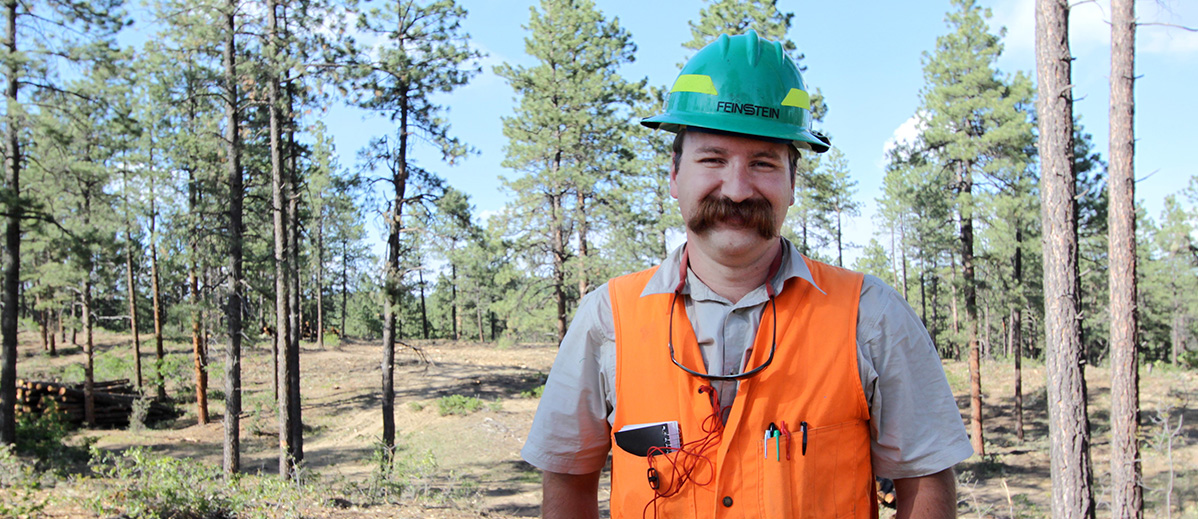
Growing up in the Colorado Rockies, Jonas Feinstein, with USDA’s Natural Resources Conservation Service (NRCS), could be found exploring local woods and streams. He gained a better appreciation for the land, spending summers in Iowa, working on his uncle and aunt’s pig, corn and soybean farm where he learned firsthand, the power of community. Watching and joining neighbors who rolled up their sleeves to support each other, Jonas gained that deep-rooted understanding of community-led stewardship. That experience, combined with his background in forestry and conservation, helped shape his career focus on integrating science with conservation on-the-ground. In this Ask the Expert, the Western National Technical Support Center professional discusses those same concepts of collaborative, science-based planning that he witnessed growing up, and moves past the mechanics of clearing brush and thinning trees to discuss what it truly takes to holistically build a resilient, fire-ready landscape.
How does combining science with thoughtful dialogue between planners and landowners lead to stronger conservation outcomes?
Strong conservation outcomes are built on three things: sound science, authentic dialogue and strong investment.
The conservation planning process is not a checklist—it is a relationship-building process. Trust is developed through what I call the “conservation conversation,” where the planner and landowner work together to understand conditions, explore options and make informed decisions.
When that process is rushed or bypassed, the result is often incomplete—or worse, ineffective management that can have long-term, negative consequences. When it is done well, it creates a shared understanding and a willingness to think beyond short-term fixes.
NRCS’s 9-step planning process exists for a reason. It provides the structure needed to translate science into action, and action into outcomes. My role, working across the West, is to support state and field staff, and partners in using that process efficiently and effectively—while also helping them see opportunities to approach forestry in ways that are more integrated, more durable, and ultimately more impactful.
How does presenting clients with clear, ecological information and multiple management pathways improve the quality of decisions for forests, communities and the broader public?
Better decisions come from better information, and from presenting that information clearly.
A strong conservation or forest management plan links goals to measurable objectives, and those objectives to a well-defined vision of desired future conditions. It answers two simple but powerful questions: how do we measure success, and what will this forest and landscape look like if we succeed?
Equally important is presenting relevant management alternatives. Forestry is often described as “more art than science,” but that undersells the discipline, and dismisses the generous amount of knowledge that science has contributed. More accurately, I like to say, forestry is “the artful application of science.” Forest density, species composition, the balance of age or size classes, and the spatial arrangement of those factors can all be clearly defined and understood, and management can improve all of them simultaneously within a given ecological site. Some approaches are better than others in achieving a single goal versus multiple goals.
When we clearly communicate ecological conditions, expected outcomes, and tradeoffs among alternatives, we move away from a “trust me” approach and toward a transparent, informed decision-making process. That shift builds confidence—not only for the landowner, but for the conservation planner/forester, and broader public who can be skeptical of what forestry is doing and how they benefit from the actions and investments in these landscapes.
Forest management often produces benefits that extend beyond the landowner—to watersheds, communities, taxpayers and local forest industries. How does conservation planning help align these interests and benefit both the landscape and the people who depend on it?
Forest management decisions should rarely stop at the property boundary. Demonstrating how management succeeds on a per acre scale, is different than how management is conveyed across the ownership boundary and vice versa. Integrating both scales into an action-oriented approach is essential to helping our clients achieve broad goals for the values we all care about like watersheds, wildlife habitat, wildfire behavior, local economies and community resilience.
Thoughtful conservation planning helps landowners see those connections—and make decisions that align personal goals with broader landscape outcomes. There are always tradeoffs. A narrow focus on rapid wildfire mitigation, for example, may produce large volumes of slash or low-value material that demand immediate solutions. A more integrated approach, grounded in ecological objectives can achieve wildfire risk reduction while also enhancing habitat, improving forest structure and supporting local forest product utilization.
The goal is not to create a bunch of work for the planner, nor is it to eliminate tradeoffs, but to make each relevant alternative visible. When landowners understand the full range of outcomes, they are better positioned to choose strategies that deliver benefits, not just per acre but have a multiplier effect across the landscape.
How do you encourage neighboring landowners to collaborate, and why is scale so critical for meaningful forest restoration?
Scale is one of the most limiting and most important factors in forest conservation.
A single landowner working in isolation, surrounded by degraded or high-risk conditions, may see limited results. In some cases, especially in fragmented ownership patterns, their goals cannot be fully achieved without broader coordination. Having a shared vision with consistent, desired future conditions is critically important. It avoids what I call, “random acts of conservation.”
Encouraging collaboration starts with demonstrating relevance. When landowners see how their actions connect to neighboring properties and how shared challenges like wildfire, insects, or watershed health transcend boundaries, they become more open to working together.
Successful landscape-scale efforts are built on trust, shared understanding and practical coordination. When those elements come together, the impact is exponential. Treatments become more effective, risks are reduced more meaningfully, and outcomes become durable at the scale that ecosystems function.
How do you help landowners, who want quick results, understand and see the value of long-term, ecological outcomes that may take years to fully unfold?
Landowners are right to want results they can see and feel, quickly. The key is not to dismiss that urgency, but to connect it to long-term outcomes. On the other side of the coin, they can also feel uncomfortable with the vision because the actions to meet their needs, given the ecology of the site, can be stark. I relish that dialogue because that is where the professional and patient dialogue with the client begins, regarding the basic story of their land, what they care about most, and how together, we can develop a long-term vision of success, not just for wildfire, but the whole suite of resource concerns.
Long-term actions should be framed as the first step in a longer trajectory. For example, a fuel reduction treatment is not the end goal—it is one component that moves the forest toward a more resilient condition. I like to encourage planners to take the attitude, “when the client comes in the door because of the fear of wildfire, they leave inspired to improve the forest for wildlife and forest health, while meeting and exceeding benefits related to fuels reduction.”
Helping landowners visualize that future is critical. When they can see how today’s actions contribute to healthier, more stable forest years or decades down the road, the value of long-term thinking becomes tangible. In practice, this means pairing immediate wins with a clearly articulated vision of desired future conditions, showing how each step builds toward that vision of success.
Looking ahead, what innovations or approaches do you hope to see more widely adopted to strengthen community resilience, forest health and landowner participation?
NRCS can continue to build upon its foundation of professional, technical excellence and customer service—where planning is timely, diligent, science-based and clearly communicated. This supports our state specialists and planners to deploy tools like the Forest Vegetation Simulator, which can demonstrate to the client what management alternatives will look like, post treatment. Building and supporting a technical program where an integrated ecological understanding is not optional but foundational, would also be ideal. I also hope to see landowners more engaged as active partners in shaping outcomes.
Equally important is advancing approaches that embrace complexity rather than simplify it—integrating wildfire resilience, forest health, wildlife habitat, water quality and working lands into implementable and cohesive strategies. If we do that well, we will not only improve individual projects, but we will also strengthen the resilience of entire landscapes and the communities that depend on them.
 Loans and Grants
 Disaster Planning and Assistance
 Conservation
 Ag Business
 Farm Life