



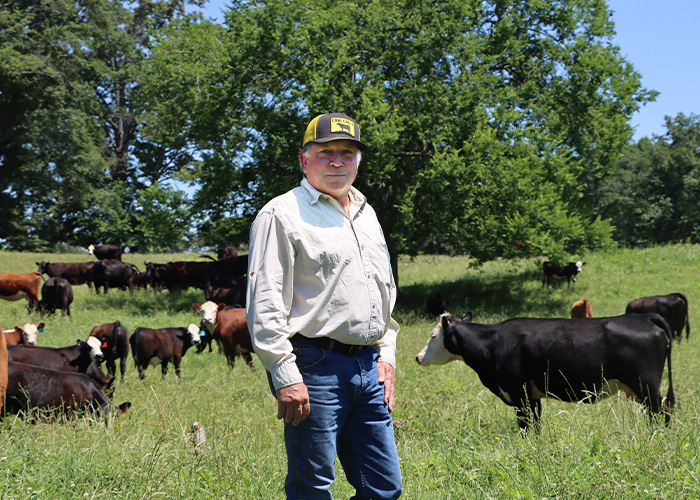
This Friday, meet Peyton Randolph of Cane Creek Cattle Co. in Yazoo County, Mississippi. While originally an attorney by profession, Peyton’s deep-rooted connection to the land goes back to his childhood days on his grandfather’s farm. His passion for land, cattle, timber, and the environment has guided his career trajectory and personal pursuits. Over the last two decades, this passion has blossomed through his cattle operation, which is made up of 350 head of cattle. However, transitioning from law to ranching has been both a challenge and a rewarding journey, as managing livestock is a constant learning process.
Reviving the Land
Peyton first ventured into cattle ranching with a piece of land that had previously been farmed using conventional methods, leading to severely degraded soil. In 2016, with a clear vision to restore his land, Peyton sought assistance from USDA’s Natural Resources Conservation Service (NRCS). Together, they embarked on a mission to revive the land's health.
Peyton’s approach to his operation is a fundamental truth: a cow/calf operation is essentially about being a grass farmer. Cattle naturally forage on grass and legumes, converting plants into protein. Understanding this relationship, Peyton took significant steps towards sustainable farming practices. By minimizing soil compaction and maximizing grass growth, he sought to create an environment that promotes both soil health and cattle well-being.
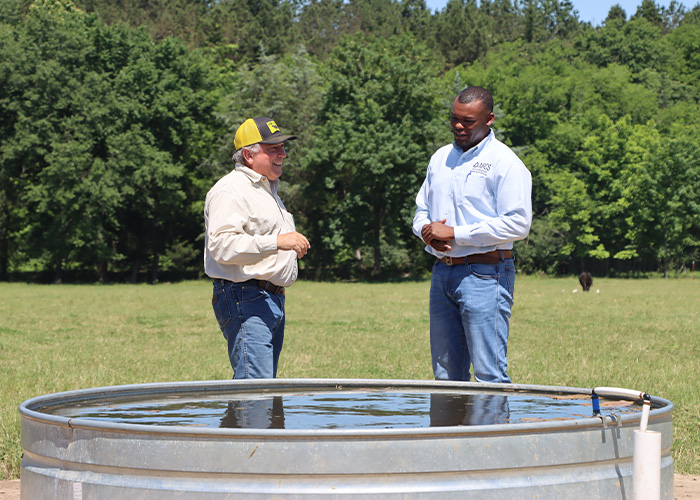
To set this vision in motion, the NRCS’ Environmental Quality Incentives Program (EQIP) enabled him to install crucial infrastructure, such as cross fencing and watering facilities, develop a rotational grazing system, and enhance his forage production, soil quality, and cattle nutrition.

The benefits of Peyton’s integrated practices are tangible. By employing rotational grazing, he efficiently utilizes all available grass in a paddock, while the concentrated presence of cattle naturally fertilizes the land, thanks to the manure and urine distributions. Moreover, NRCS assistance has helped protect heavily used areas from mud and sediment runoff, ensuring that land degradation is minimized.
“Being a partner and participant with NRCS has been a rewarding experience for myself, Cane Creek Cattle Co., and the environment,” said Peyton.
A Dual Perspective
NRCS has also assisted Peyton with pasture and hay planting. Perennial grasses were planted to optimize forage production, reduce soil erosion, improve soil quality, and enhance livestock nutrition. For the months when grazing is not possible, Peyton strategically placed feeding pads for supplemental feeding using the Heavy-Use Area Protection conservation practice. This reduced compaction from high concentrations of cattle around water facilities and feeding troughs.
Record-keeping is paramount at Cane Creek Cattle Co., and Peyton utilizes a sophisticated program that monitors every aspect of his herd. Each animal is tagged and tattooed for identification. The system tracks vital information, including birth dates, weights, vaccination records, and lineage. To guarantee the safety of both calves and their mothers during the birthing process, a “calf catcher,” attached to a UTV, is deployed to contain newborns while allowing the mothers to bond with their offspring.
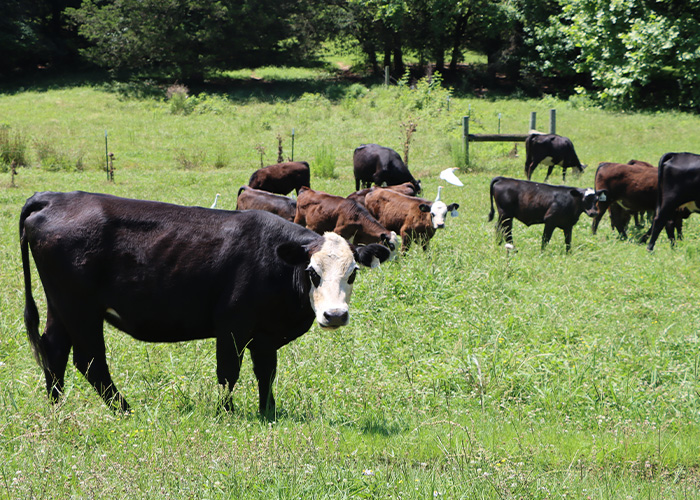
With a unique dual perspective as both an attorney and a cattle farmer, Peyton’s goal is to raise the best beef cattle possible while minimizing monetary input and maintaining the health and welfare of his livestock. His commitment extends beyond his cattle to encompass the environmental stewardship of the land he tends daily.
More Information
Visit local farms, ranches, forests, and resource areas through our Fridays on the Farm stories. Meet farmers, producers, and landowners who are working to improve their operations with USDA programs.
USDA offers a variety of risk management, disaster assistance, loan, and conservation programs to help producers weather ups and downs in the market, recover from natural disasters, and invest in improvements to their operations. Learn about additional programs.
For more information about USDA programs and services, contact your local USDA service center.
Tommi Matthews is a public affairs specialist for NRCS in Mississippi.
 Loans and Grants
 Disaster Planning and Assistance
 Conservation
 Ag Business
 Farm Life